A child with eczema, psoriasis, vitiligo, alopecia areata or a birthmark does better when the condition is treated as ordinary: a doll that looks like them, a storybook that explains it to the class, a camp where everyone has something going on with their skin, and a lotion routine that feels like play instead of a chore. This page gathers the toys, books, programs and school resources our team is asked about most, for parents and for the pediatricians who care for these children with us. Every link was checked in October 2026. Belaray Dermatology has no financial relationship with any maker, publisher or organization listed here, with one exception: some product links go to Amazon, and as an Amazon Associate, Belaray Dermatology earns from qualifying purchases. Nothing on this page replaces an exam with your child’s dermatologist or pediatrician.
On this page: Dolls and plush · Books · Lotion time and wet wraps · Camps and peer programs · School and daycare · A short history of the doll · Role models
Why Does Representation Matter for a Child with a Skin Condition?
Children notice difference early, and classmates ask about it. A doll or plush toy that shares the child’s condition turns the condition into something that can be held, named and played with, and a picture book gives the child the words to explain it. Early results from a Children’s Mercy study presented at the 2024 Society for Pediatric Dermatology meeting found that about 80 percent of parents reported a positive effect on their child’s self-image or confidence after reading a storybook about the condition; the survey was parent-reported and small, so treat it as encouraging rather than proof (MDedge report). Play also has a practical side: a plush with its own lotion bottle makes a toddler’s moisturizing routine easier, and a doll that gets “cream” first is a standard play-therapy approach for a child who resists treatment.
Dolls and Plush Toys That Look Like Your Child
Vitiligo
 Miniland “My Friends & Me” doll with vitiligo (Miniland, Spain; ages 10 months to 6 years; about $60). A 15-inch soft-vinyl baby doll with vitiligo patches, made for younger children rather than collectors. Miniland product page · Amazon.
 Barbie Fashionistas #135 with vitiligo (Mattel, 2020; ages 3 and up), #171 with vitiligo (2021, a curvy doll with a lighter skin tone) and Ken #192 with vitiligo (2022). Mattel designed the first with a board-certified dermatologist. All three are retired from the current line and sold only by third-party resellers, often at collector prices: #135 · #171 · Ken #192.
- Rainbow High “Jewel Richie” (MGA Entertainment, Series 4, 2022; typically ages 6 and up). A fashion doll with vitiligo; the same series includes Delilah Fields, a doll with albinism who wears glasses. No longer in stores; available on resale sites.
 LEGO minifigures with vitiligo. LEGO’s first minifigure with vitiligo arrived in a 2022 table-football set, and reviewers read the lighter patch around one eye of “Mateo,” the hero of the DREAMZzz sets (ages 7 and up), as vitiligo too, though LEGO has not said so officially. A good “spot the representation” moment for LEGO fans. Brick Fanatics on the first vitiligo minifigure · Mateo minifigure on Amazon.
Eczema and psoriasis
- Plushie Dreadfuls Eczema Rabbit (about $45) comes with its own plush lotion bottle, which makes it a natural prop for “bunny gets lotion first.” The Psoriasis Rabbit ($50) wears a sun on its chest for phototherapy. Eczema Rabbit · Psoriasis Rabbit.
 GIANTmicrobes Psoriasis plush (ages 3 and up; $14.95). A plush skin cell with textured dry patches and an educational card; the same maker sells a Pimple plush ($12.95) that teens find funny. GIANTmicrobes Psoriasis · Amazon.
Alopecia areata
- Brave Barbie and Brave Ken (Mattel with the National Alopecia Areata Foundation; free). Hairless dolls given to children with alopecia areata through NAAF events and support groups, not sold at retail. More than 120,000 have been distributed since 2013, and the newer Brave Ken has a rooted wig. Quantities are limited each year. How to request a Brave Barbie.
Birthmarks and any visible difference
- Kikili birthmark dolls with the Vascular Birthmarks Foundation ($60 to $90). A small U.S. maker reproduces a child’s port-wine stain or hemangioma on a 14- or 16-inch doll from the family’s photos; $10 from each doll goes to the foundation. Kikili VBF birthmark dolls.
- A Doll Like Me (nonprofit; free to families). Custom dolls made to match any visible difference, including birthmarks and albinism, funded by donations. Expect a waiting list. A Doll Like Me.
Children’s Books by Condition
Vitiligo
 Simply Winnie by Winnie Harlow, illustrated by Sawyer Cloud (Penguin Workshop, 2026; ages 4 to 8). The model, diagnosed at 4, draws on her own childhood. Publisher page · Amazon.
 I Absolutely, Positively Love My Spots by Lid’ya C. Rivera, illustrated by Niña Mata (HarperCollins, 2023; ages 4 to 8). Includes a letter from the author and vitiligo facts for parents. Amazon.
 The Vitiligo Research Foundation keeps a list of 27 vitiligo books for ages 2 to 12, including Ava’s Colors Are Her Own, written by a dermatologist (Amazon), Beautifully Blemished, which covers vitiligo, birthmarks, scars and eczema (Amazon), and the middle-grade novel How to Disappear Completely (Amazon). VRF book list.
Eczema
 Mitchell Itches: An Eczema Story by Kristin Kelly, illustrated by Amelina Jones (EK Books, 2024; ages 4 to 8). A boy with eczema faces teasing and finds the guitar as a distraction; management tips at the back. Publisher page · Amazon.
- We Feel Itchy! Living with Eczema (Eczema Society of Canada; free PDF). A picture book written with dermatology, pediatrics and psychology input, showing children of many skin tones. Download the book.
 Can I Tell You About Eczema? by Julie Collier (Jessica Kingsley Publishers, 2015; ages 7 and up). Written for classmates, friends and teachers. Publisher page · Amazon.
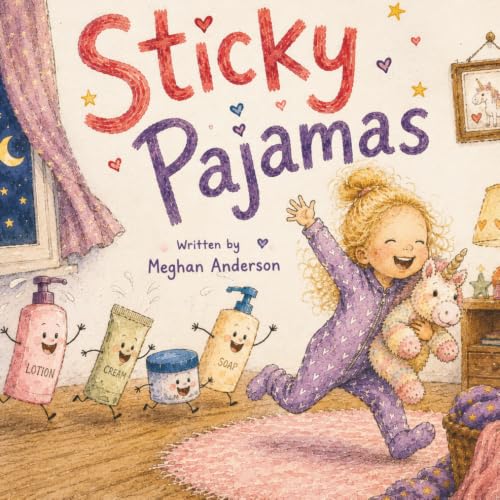 Sticky Pajamas by Meghan Anderson (2025). A bedtime story about eczema, itchy skin and the lotion routine, written by a parent. Amazon.
Alopecia areata
 What’s Silly Hair Day with No Hair? by Norene Paulson, illustrated by Camila Carrossine (Albert Whitman, 2021; ages 4 to 8). Bea has alopecia areata and school spirit week is coming; the back matter explains hair loss in children. Publisher page · Amazon.
- A Kids Book About Alopecia by Bergson Van, a Boston elementary-school student, with his mother Karen Lee (A Kids Co., 2023; ages 5 and up). Part of the plain-language “A Kids Book About” series and of the Children’s Alopecia Project library program. Publisher page.
Psoriasis
- The Adventures of Ariya: I Am Unique by Skylar Tyson, who wrote it at age 10 (National Psoriasis Foundation; free download; ages 7 to 10). Teaches that psoriasis is not contagious and is part of who you are. Download from the NPF.
Birthmarks and albinism
 Buddy Booby’s Birthmark by Evan Ducker, written as a child with a facial port-wine stain, is hard to find in stores but is listed on Amazon; the Vascular Birthmarks Foundation adopted Buddy as its mascot and runs a yearly read-along. Amazon · Vascular Birthmarks Foundation.
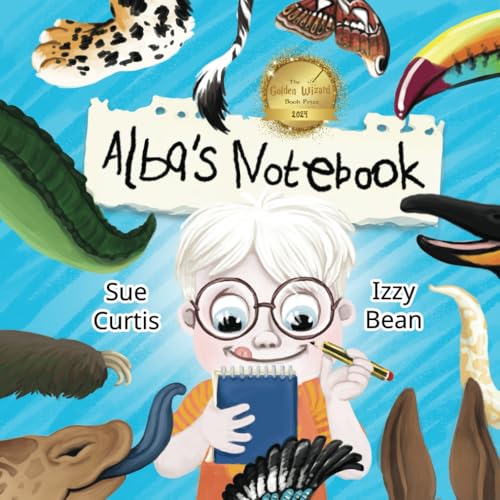 NOAH’s book list for albinism includes picture books such as Alba’s Notebook and Alley: I Have Albinism, plus free PDFs for young readers. NOAH books · Alba’s Notebook on Amazon.
Teens
 Skin Conditions in Young People: A Practical Guide on How to Be Comfortable in Your Skin by Tess McPherson, a pediatric dermatologist (Oxford University Press, 2022). Acne, eczema, alopecia, psoriasis and vitiligo, written for teenagers. Amazon.
Head lice (a common scalp nuisance, not a skin disease)
The most common reason a note comes home from school. Lice are a nuisance, not a sign of poor hygiene, and these books take the panic out of them. The practical answer first: the American Academy of Pediatrics says a child should not miss or be excluded from school because of head lice, and it discourages “no-nit” policies (AAP guidance on head lice).
 Bugs in My Hair! by David Shannon (Blue Sky Press, Scholastic, 2013; ages 4 to 8). Funny and factual: where lice come from, how they are treated, and why the whole family gets checked. Amazon.
 Scritch Scratch by Miriam Moss, illustrated by Delphine Durand (Orchard Books, 2002; ages 5 to 8). Narrated by a louse looking for a new head to live on; the classroom cleanup is part of the story. Amazon.
 Head Lice by Elise Gravel, from the Disgusting Critters series (Tundra Books, 2016; ages 6 to 9). A short, gross-out nonfiction book that children read on their own. Amazon.
- Bugs in My Hair?! by Catherine Stier, illustrated by Tammie Lyon (Albert Whitman, 2008). Ellie gets lice and her class learns what to do. Out of print, so look for it at the library.
Warts and molluscum
We looked hard and could not find a storybook about warts or molluscum. If you know one, tell us. Two things parents should know in the meantime:
- Molluscum is worth treating, not watching. Molluscum bumps spread on the child, often to sensitive areas, and to brothers and sisters at home, and the longer they are left the more there are to treat. Belaray treats molluscum and warts in children at both offices; see our pediatric dermatology page and book a visit when the first bumps appear. Until the visit, discourage picking and scratching, cover the bumps for contact sports, and keep bath water and towels separate from siblings.
- Society for Pediatric Dermatology warts handout (revised 2024), in English and Spanish, explains what warts are and how they are treated. Warts handout · All SPD family handouts.
 Warts and All: A Book of Unconditional Love by Lori Haskins Houran, illustrated by Sydney Hanson (Albert Whitman, 2017; a 2018 Paterson Prize winner). Not a medical book, just a picture book about being loved exactly as you are, and the title does the job for a child who feels self-conscious. Amazon.
How Do I Make Lotion Time and Wet Wraps Easier?
Most of the battle with childhood eczema is the routine, not the medicine. These free, evidence-based resources are the ones we point families to:
- Build an “itch basket.” The American Academy of Pediatrics suggests a basket of stress balls, puzzles and bubble wrap for little kids, and drawing, tongue twisters or building games for older ones, so the child has something to do with their hands instead of scratching. Teach a competing response: pat the itch, or squeeze a smooth stone. AAP: helping kids cope with the itch.
- Same time, same order, every day. Moisturize at least twice a day, within minutes of the bath, and let the child apply cream to a doll or plush first. AAD tips for a child with eczema.
- Reward charts. Printable animal and fairy charts and a blank treatment record from Eczema Care Online, a university-built program. Printable charts. The Australian version adds a two-week moisturizer challenge and a five-minute guided relaxation for children. Eczema Support Australia toolkit.
- Wet wraps, shown step by step. Two hospital-made videos: the Children’s Mercy wet-wrap video and the National Jewish Health wet-wrap video. Use them only when your dermatologist has prescribed wet-wrap therapy; the wrap goes over the medication your provider chose.
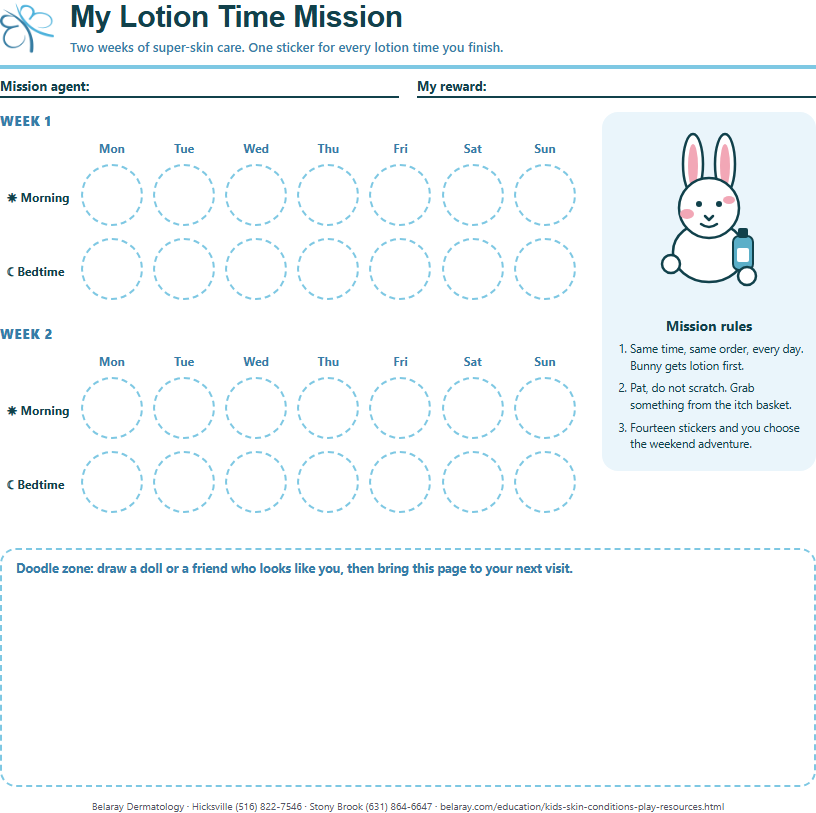
- Print the Belaray “Lotion Time Mission” chart. Two weeks of morning and bedtime circles for stickers, three mission rules, and a bunny who gets lotion first. Download the chart (PDF); the Spanish version is on the Spanish page. On the back, invite your child to draw a doll or a friend who looks like them, and bring it to the next visit; we love seeing them.
 Scratch sleeves for babies and toddlers. Silk-mitt sleeves such as ScratchSleeves stay on overnight better than loose cotton mittens; short nails and cotton gloves at night work for older children. ScratchSleeves · ScratchSleeves on Amazon.
- Know what a flare looks like on your child’s skin. On darker skin, eczema is often less red and more gray, brown or purple, and it is easy to mistake for dryness. See our page on dermatology for skin of color.
Camps and Peer Programs for Kids with Skin Conditions
- Camp Discovery (American Academy of Dermatology; ages 8 to 16; free, often including airfare). A one-week camp for children with any chronic skin condition, staffed by dermatologists and nurses. The 2026 session nearest Long Island was in Andover, Connecticut, in August; 2027 dates post on the same page. A dermatologist referral is required, and we are glad to complete it at a visit. Camp Discovery dates.
- Camp Wonder (Children’s Skin Disease Foundation, a California nonprofit; ages 6 to 16; free). A medically staffed camp that also welcomes children with serious skin diseases such as epidermolysis bullosa and ichthyosis; the camp location varies by year. Children’s Skin Disease Foundation.
- NAAF Youth Mentor Program (ages 5 to 18; free). Matches a child with a young adult mentor who has alopecia areata for a year of calls. NAAF also lists a New York virtual support meeting. Youth Mentor Program.
- Children’s Alopecia Project runs CAP Kid groups, a yearly family camp (free for kids) and mentor matching. Children’s Alopecia Project.
- NPF “Our Spot” (National Psoriasis Foundation; under 18; free). A welcome kit, webinars, a youth ambassador program and peer pairing for kids and teens with psoriasis or psoriatic arthritis. Our Spot.
- VITFriends Pen Pal Patch (ages 4 to 12) and Purple Patch Teen, national vitiligo peer groups with a New York chapter. Pen Pal Patch. The Global Vitiligo Foundation holds a two-day Camp Victory each year. Global Vitiligo Foundation.
- Vascular Birthmarks Foundation, based in Latham, New York, offers new-parent packages, a parent network, a physician referral list and a yearly New York City clinic. Vascular Birthmarks Foundation.
- NOAH New Parent Program matches families of a child with albinism to a trained parent liaison and sends a guidebook; NOAH’s family camp in New Hampshire runs in odd years (next in July 2027, ages 7 and up with a parent). NOAH New Parent Program.
- debra of America (epidermolysis bullosa). A New Family Advocate program with a free care package for newly diagnosed families, mentors for parents, legal help with school and insurance, and a list of EB camps including the free Camp Spirit Colorado for ages 9 to 18. New Family Advocate program · EB camps.
- FIRST, the Foundation for Ichthyosis and Related Skin Types. A new-family welcome kit, newborn and NICU guides, regional family meetups and a national conference with scholarships. FIRST new-parent information.
- National Eczema Association. There is no in-person Eczema Expo in 2026; a redesigned Expo returns in 2027, and NEA runs virtual support groups and periodic free New York events. NEA eczema and children.
We did not find a condition-specific in-person group for children in Nassau or Suffolk County. If you know of one, tell us and we will add it.
School and Daycare Support
- Eczema: Tools for School (National Eczema Association; free). Teacher discussion guides, classroom trigger strategies, a care-kit checklist and guidance on 504-plan accommodations. Tools for School.
- “Skin Conditions in Students” handouts for school nurses and teachers (Society for Pediatric Dermatology; free; English and Spanish). One-page sheets on alopecia areata, eczema, psoriasis and vitiligo, plus a coping plan for parents and counselors. Print one and send it in with your child. SPD school handouts.
- NPF school resources. Ready-made letters from parents to teachers, a letter for classmates’ families, and a provider letter for 504 coordinators that a dermatology office can print on letterhead. NPF school resources.
- NAAF Alopecia Areata School Guide, including bullying facts, a “do you need a 504 plan” section and help with head-covering exceptions to dress codes. NAAF advocacy in schools.
- Sunscreen at school in New York. Under New York Education Law section 907, a student may carry and apply their own sunscreen with a written note from a parent; no physician’s order is needed, and the parent supplies the sunscreen. Districts may add rules such as no spray cans. This matters for children with vitiligo or albinism and for any child on a photosensitizing medication. The law covers schools; daycare centers set their own rules, so ask yours for its sunscreen form. Education Law section 907.
- AAD Good Skin Knowledge lesson plans (ages 8 to 13; free). Classroom-ready sun-safety and skin-health lessons for teachers and camp counselors. Sun-safety lesson plan.
A Short History of the Doll, from the Nile to Vitiligo Barbie
Children have played with dolls for at least four thousand years, and for most of that time every doll looked the same. The last decade is the first in which a child can walk into a store and find a doll with her skin condition. Here is the quick version.
- about 2000 BC The oldest dolls we know of are flat wooden paddle dolls with beaded hair, found in Egyptian tombs from as early as the 21st century BC.
- about 200 BC Greek and Roman children played with clay dolls jointed at the hips and shoulders. Greek girls dedicated their dolls to the goddess Artemis when they married.
- 1840 to 1900 German china dolls and French and German bisque dolls sold in the millions. Some 19th-century Jumeau and Bru dolls now sell for the price of a car.
- 1912 Rose O’Neill’s Kewpies, drawn for a magazine in 1909, became bisque dolls in Germany. The name comes from Cupid.
- 1915 Johnny Gruelle patented Raggedy Ann; the first book followed in 1918.
- 1959 Barbie debuted at the New York Toy Fair on March 9 for three dollars. Ruth Handler adapted her from a German doll called Bild Lilli and named her after her daughter. Ken arrived in 1961.
- 1968 Christie, the first Black doll in the Barbie line. The first doll sold under the name Black Barbie followed in 1980.
- 1983 Cabbage Patch Kids came with a birth certificate and adoption papers, and that holiday season parents lined up around the block for them.
- 1986 Pleasant Rowland’s American Girl dolls told history through the eyes of girls; the contemporary line that lets a child pick a doll with her own eye, hair and skin color (now Truly Me) followed in 1995.
- 1997 Share a Smile Becky, Barbie’s friend in a pink wheelchair.
- 2013 Brave Barbie, a doll with no hair made for the National Alopecia Areata Foundation and given to children rather than sold.
- 2016 Barbie Fashionistas added tall, petite and curvy bodies.
- 2019 A Barbie in a wheelchair designed with UCLA Mattel Children’s Hospital, and a doll with a removable prosthetic leg developed with a 13-year-old activist, Jordan Reeves.
- 2020 The first Barbie with vitiligo (#135), designed with a dermatologist, and a Barbie with no hair.
- 2022 Ken with vitiligo and Barbie with behind-the-ear hearing aids; Rainbow High’s Jewel Richie (vitiligo) and Delilah Fields (albinism); and LEGO’s first minifigure with vitiligo, hiding in a table-football set.
- 2023 to 2026 Barbie with Down syndrome (with the National Down Syndrome Society), a blind Barbie (with the American Foundation for the Blind), a Barbie with type 1 diabetes, and an autistic Barbie.
Did You Know?
- Barbie’s full name is Barbara Millicent Roberts, and Ken’s is Kenneth Sean Carson.
- Raggedy Ann is older than sliced bread, which was first sold in 1928.
- Cabbage Patch Kids were never “sold.” You adopted them, papers and all.
- Greek girls kept their dolls until their wedding day, then gave them to a goddess.
Role Models Kids Can Point To
- Winnie Harlow, the model and author with vitiligo, diagnosed at age 4.
- Josh Dobbs, NFL quarterback with alopecia areata since third grade and NAAF’s national spokesperson: “Alopecia shouldn’t stand in your way.” NIH MedlinePlus interview.
- Charlie Villanueva, former NBA forward with alopecia universalis and longtime NAAF spokesman.
- Rasheed Wallace (NBA) and the ballerina Michaela DePrince, both with vitiligo. DePrince, who was shunned for her vitiligo as an orphan in Sierra Leone and went on to dance with the Dutch National Ballet and Boston Ballet, died in 2024 at 29; her story is still one worth sharing. VRF list of well-known people with vitiligo.
- Jonathan Scott, former NFL lineman with psoriasis who worked with the NPF youth ambassador program.
We have not found a mainstream children’s television series with a lead character who has vitiligo or alopecia; representation has arrived in toys and books first.
A Note on Prices and Availability
Prices and stock were checked in October 2026 and change often; several of the dolls above were made in limited runs and are now resale only. Belaray Dermatology does not sell any of these items and lists them because families ask. As an Amazon Associate, Belaray Dermatology earns from qualifying purchases made through the Amazon links; every other link is a plain link. If a link stops working or you find something we should add, let us know at your next visit.
Frequently Asked Questions
Are there dolls with vitiligo, eczema or psoriasis?
Yes. Mattel made Barbie Fashionistas #135 (2020), #171 (2021) and Ken #192 (2022) with vitiligo, Rainbow High made Jewel Richie with vitiligo, and Miniland makes a 15-inch baby doll with vitiligo for children as young as 10 months. For eczema and psoriasis the choices are plush toys rather than fashion dolls: the Plushie Dreadfuls Eczema Rabbit and Psoriasis Rabbit and the GIANTmicrobes Psoriasis plush. No major toy maker currently sells a fashion doll with eczema or psoriasis.
How can my child get a free Brave Barbie or Brave Ken for alopecia?
Through the National Alopecia Areata Foundation, which distributes the dolls at its Walk for Alopecia events and through local support groups rather than in stores. Quantities are limited each year, so contact NAAF early. Brave Barbie comes in two skin tones with five accessories, and the newer Brave Ken has a rooted wig.
Is there a summer camp for kids with skin conditions near Long Island?
Camp Discovery, run by the American Academy of Dermatology, is free for children ages 8 to 16 with any chronic skin condition and often covers airfare. The closest 2026 session was in Andover, Connecticut, in August. A dermatologist referral is required, and your Belaray provider can complete it at a visit. Camp Wonder in Georgia is a second free option for ages 6 to 16.
Can my child bring sunscreen to school in New York?
Yes. Under New York Education Law section 907, a student may carry and apply sunscreen at school with written permission from a parent or guardian. No doctor’s note is required, the parent supplies the sunscreen, and the school district may set rules such as no aerosol sprays. Ask the school nurse for the district’s permission form.
How do I explain my child’s eczema or alopecia to their class?
Send a one-page handout and a picture book. The Society for Pediatric Dermatology publishes free handouts for school nurses and teachers on alopecia areata, eczema, psoriasis and vitiligo in English and Spanish, and the National Psoriasis Foundation offers letters for classmates’ families. Books such as Can I Tell You About Eczema? and What’s Silly Hair Day with No Hair? are written to be read aloud to a class.
How do I make moisturizing or wet wraps easier for a toddler?
Keep the same time and order every day, let the child apply cream to a doll or plush first, and give the child something to do with their hands. The American Academy of Pediatrics suggests an itch basket of stress balls, puzzles and bubble wrap, and a competing response such as patting instead of scratching. Printable reward charts and hospital wet-wrap videos are linked on this page. Use wet wraps only when your dermatologist has prescribed them.
Related reading: pediatric dermatology at Belaray, eczema in children, vitiligo treatment, psoriasis treatment, hair loss and alopecia areata, the sunscreen guide, and the patient education hub.
Does Your Child Need a Dermatologist?
We see infants, children and teens at both offices for eczema, psoriasis, vitiligo, alopecia, birthmarks, molluscum, warts and acne. Book online, text us, or call either office.
Book Online 💬 Text Us: (516) 822-7546 📞 Hicksville: (516) 822-SKIN 📞 Stony Brook: (631) 864-MOHS